What do you know about cross-border e-commerce? How to do it well?

From 2016 to 2018, the scale of cross-border e-commerce transactions in China continued to rise, from 6.3 trillion yuan to 9.1 trillion yuan, and this growth trend is expected to continue.
First, cross-border e-commerce?
Cross-border electronic commerce refers to an international business activity in which transaction subjects belonging to different customs reach a transaction, make payment and settlement through e-commerce platform, and deliver goods and complete the transaction through cross-border logistics.
How do individuals do cross-border e-commerce?
1. Distinguish between foreign trade and cross-border e-commerce.
Although foreign trade now uses the internet, it can be understood as foreign trade e-commerce: but the whole foreign trade transaction process has not changed much, including inquiry, quotation, order, production, transportation, chartering and booking, customs declaration and commodity inspection, verification of foreign exchange collection and settlement, etc. Foreign trade e-commerce transactions are all offline.
Cross-border e-commerce is sold through the third platform, just like domestic sales on Taobao. The difference is that with the help of foreign platforms (such as Amazon, ebay, etc.) or domestic sales platforms to foreign countries (AliExpress, etc.), cross-border e-commerce is directly completed online. Compared with traditional trade, single orders of cross-border e-commerce are mostly small batches or even single pieces. (Welcome to correct me)
2. What are the cross-border e-commerce platforms? What can an individual do?
The mainstream is Amazon, eBay, wish and AliExpress (owned by AliExpress Alibaba); There are lazada and shopee in Southeast Asia.
Nowadays, most platforms require enterprises, and it is still difficult for individuals to do cross-border e-commerce. What individuals can do now are Amazon (although it is possible, it is basically very difficult to pass), eBay and wish.
3. Market choice
Xiao Bian thinks that we have to look at the market before selecting products. Although many people feel that there is no single order to do lazada now, most people’s main battlefields are America and Europe, but Xiao Bian thinks that the potential markets such as Southeast Asia, India and Africa are relatively large, but now if we specialize in two places, it seems a little bit to support ourselves, so it is better to take care of Southeast Asia and Africa for the time being!
4. Selecting products and opening stores
Suggest using the company to open a shop. Like trademarks, it is a trend. I feel that a few individuals can still open stores, and maybe they will want a company in a few years! It will be troublesome then. You can pay more attention to the hot-selling products of some platforms, or pay more attention to their markets and develop your own products!
5. I won’t elaborate on logistics, collection and operation. In addition, VAT tax in various countries is also a more important one now!
Second, choose products! ! !
Selection: always the first step in marketing.
Product selection has always been the most talked about and the core topic of cross-border e-commerce. For the selection of products on different platforms, the core is to make the selection after understanding the platform. The same product can learn from each other in different platform marketing methods, and refined product selection thinking is the core! Here is an example to illustrate the product selection thinking of amaon platform.
Amaon’s selection
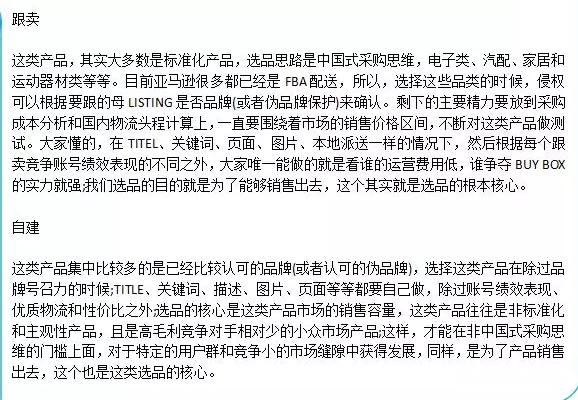
When it comes to Amazon, the first thing that comes to mind is that it is suitable for branding, high gross profit and so on! However, for many Chinese sellers, the route that Amazon left us to sell products was just "following LISTING" and "self-built listing"; The way of self-built LISTING is suitable for the brand and pseudo-brand strategy that everyone is keen on at present; Of course, if it is a simple OEM, this route is actually very tiring.
Then, in this environment, how should we China sellers choose products?
Third, warehousing
Warehousing: Pay attention to the risks of overseas warehouses.
Xiaobian here talks about this matter from the aspects of shelf space specification, commodity information management specification and process design, of which the first two are infrastructure construction and the latter is system application.
1. Specification for existing shelves in storage space
Shelf position information refers to the arrangement of the storage places of inventory goods according to their positions, and the serial numbers are marked with unified signs, and obvious signs are made. Scientific and reasonable shelf information is conducive to the scientific maintenance of inventory goods. In the process of goods entering and leaving the warehouse, the operation can be completed quickly, accurately and conveniently according to shelf information, which can improve efficiency and reduce errors.
When compiling shelf information, we should ensure that the shelves in a warehouse are numbered in the same way to facilitate the search and processing.
2, commodity information specification
The specification of commodity information here mainly refers to the systematization and clarity of SKU information, commodity specifications and sizes, and customs declaration information in Chinese and English. The standardization of commodity information is conducive to the scientific management of inventory goods, and a reasonable SKU code is conducive to the realization of refined inventory management, as well as timely and accurate picking, improving efficiency and avoiding picking mistakes.
Among several items of commodity information, commodity specifications and sizes, Chinese and English customs declaration information can be improved by a little sorting as existing data, and commodity SKU(Stock Keeping Unit password 2: import source docking) is the most important and basic data in commodity management, but because it is not existing information, many sellers have no SKU or SKU is imperfect.
3. Process design
The process here does not refer to 4S or 5S, but refers to the sequential connection of each node’s work in the process of order, purchase, sale and inventory management under the above two standardized conditions.
In short, the daily back-end management of cross-border e-commerce sellers can be roughly divided into: order acquisition, order distribution, billing and distribution, and inventory maintenance. As for how these whole processes can be connected in series to maximize efficiency, it will be a long story to write. Here, I will talk about how ERP on the market currently circulates this series of work.
Order acquisition, automatically import platform orders into the management system through the official API interfaces of eBay, Amazon, AliExpress and Wish platforms;
Order allocation, access to the mainstream international logistics channels in the market, through user-defined distribution rules, all orders are automatically assigned to the corresponding warehouse distribution, the corresponding logistics acquisition list and tracking number according to the rules;
Make a bill and distribute goods, the order automatically obtains logistics information according to the rules, generates the face sheet and tracking number, and the picking information is also printed synchronously with the face sheet; For simple packages (packages with only one item in an order), you can scan the goods and make a bill;
Inventory maintenance, the system automatically maintains the inventory according to the delivery of the order, and automatically generates purchasing suggestions according to the inventory and the average daily sales of the near date combined with the purchasing cycle.
When the purchase comes back, it can support the continuous orders, and the process forms a closed cycle.
As for overseas warehouses, overseas warehouses are suitable for goods (batteries, powder, etc.) that are expensive, bulky and fragile and cannot be taken by traditional logistics channels.
To be an overseas warehouse, we also need to consider the financial strength and anti-risk ability of the merchants themselves. Because overseas warehouses have a characteristic, it is easy to send out and difficult to come back. The returned goods are imported, and in many cases the cost of freight and customs duties will be much higher than the value of the goods itself. This product is easy to sell in this country, but it is not universal to sell. The goods that cannot be sold will form inventory loss.
Fourth, the platform
Platform: Trilateral platform+self-built shopping mall skillfully combined.
For businesses that have just set foot in cross-border e-commerce, it is recommended to choose a third-party platform first. Third-party platforms have mature rules, which are based on the platform’s long-term experience. First of all, it can best protect the interests of buyers, and then maintain fair competition to the greatest extent.
For sellers, the advantage of the third-party platform is that the traffic can be free, and the disadvantage is that the bigger you play, the greater your strategic hidden danger. It’s hard to say one day, you made an inadvertent mistake and closed your store.
However, these hidden dangers do not exist for cross-border B2C of self-built shopping malls, because self-built shopping malls do not seek traffic but do brand endorsement. If users can search your brand online, they will feel that your brand has a foundation, which is good for remembering and trusting your brand. The significance of self-built shopping malls can never be simply understood as sales, because online means being in the state of promotion and information dissemination, so the first function is information dissemination, followed by transaction.
We also see that many merchants make a clever match between the third-party platform and the self-built B2C mall: put a leaflet of B2C mall in the delivered package, which also realizes the free promotion of their own mall.
V. Promotion
Promotion: The foundation is to have a good product.
There are five main types of product promotion:
For different products, different platforms should choose one or two suitable methods, which are not detailed here. If it is drainage outside the station, I recommend an article written by blues. This article is deep in thinking and high in realm. It is the best article of its kind that Xiaobian has read so far and is deeply moved. (Interested friends can scan the QR code below and pay more attention to us. There will be more exciting content in the future.)
Sixth, logistics
Logistics: Choose the right logistics company in four aspects.
Mainly from four aspects to measure whether this logistics company is suitable for you.
1. Look at the history of the company
2. See if the company’s service channels are comprehensive.
Different goods need to choose different logistics methods, for example, there is a limit of two kilograms for small bags. (Password 1: Eagle Bear Exchange Amazon Training) Logistics companies have a wide range of channels, so merchants do not need to look for other logistics companies and make judgments. In addition, the more goods are delivered in a logistics company, the more services you can enjoy.
3. Look at the price
Logistics costs will erode the seller’s profits, so the price is the seller’s greatest concern. But blindly lowering the price will bring serious consequences, such as abnormal operation, packet loss, unstable delivery time and so on. Pursuing only economic benefits will inevitably damage the customer experience. The vast majority of sellers will only understand if they have suffered losses in this respect.
4. Look at the overall strength of the company.
For example, whether the dot distribution is wide enough, whether there is a seamless upstream and downstream system, etc.
VII. Collection of money
Collection: Make the last pass.
The safety of funds is the first priority. If the safety of funds is not guaranteed, the channel will be easy to use. The more money you receive, the greater the risk. Just like PP, it is easy to use, but there is a risk of clearing funds, and the safety of funds is not guaranteed.
Secondly, the stability of the channel, the channel has problems at two ends every three days, which will greatly affect the collection, especially during the peak hours, not to mention the delay of one day and one hour will lose a lot of orders.
Third, the success rate of the channel, because the success rate is directly related to the actual conversion rate of orders, the higher the success rate, the higher the actual conversion rate. Others, such as account opening fee and annual fee, are secondary. On the contrary, the more attractive those conditions are, the greater the risk.
Don’t be confined to a collection channel. For yourself, the safety of capital rotation is important, and the online shopping experience of customers is even more important. Therefore, don’t be too entangled in this issue. At present, cross-border RMB collection is the choice of many foreign trade e-commerce. Because the payment page is fast, it also conforms to the shopping habits of foreign consumers. Cross-border e-commerce should always pay attention to these, users enhance the value experience, which is beneficial to stabilize the market share of foreign trade.